
Tulip Tree
Scientific Name: Liriodendron tulipifera
— pronounced lir-ee-o-DEN-dron tew-lip-IF-er-a
— Liriodendron is from Greek leirion, lily and dendron, a tree with flower
— tulipifera means bearing tulips
Family: Magnolia Family (Magnoliaceae), made up of 200-plus species, almost all tropical and subtropical. The Magnolia family contains only 2 genera,Magnolia & Liriodendron.
Other Common Names: Tulip Poplar, Yellow Poplar (but it’s not related to poplar trees, which are of the Populus genus in the Willow family), Canoewood, Lyre
Tree, Whitewood
Tulip Tree leaves are 5 to 6 inches long and wide. They have four lobes, and are slightly wedge-shaped at the base; the leaf’s apex or tip is cut across at a shallow angle, making the upper part of the leaf look square. The leaf is smooth on both surfaces, dark green and lustrous above, pale and often with a slight whitish bloom beneath.
Tulip trees produce tulip-shaped, light greenish-yellow flowers from April to June.
— pronounced lir-ee-o-DEN-dron tew-lip-IF-er-a
— Liriodendron is from Greek leirion, lily and dendron, a tree with flower
— tulipifera means bearing tulips
Family: Magnolia Family (Magnoliaceae), made up of 200-plus species, almost all tropical and subtropical. The Magnolia family contains only 2 genera,Magnolia & Liriodendron.
Other Common Names: Tulip Poplar, Yellow Poplar (but it’s not related to poplar trees, which are of the Populus genus in the Willow family), Canoewood, Lyre
Tree, Whitewood
Tulip Tree leaves are 5 to 6 inches long and wide. They have four lobes, and are slightly wedge-shaped at the base; the leaf’s apex or tip is cut across at a shallow angle, making the upper part of the leaf look square. The leaf is smooth on both surfaces, dark green and lustrous above, pale and often with a slight whitish bloom beneath.
Tulip trees produce tulip-shaped, light greenish-yellow flowers from April to June.
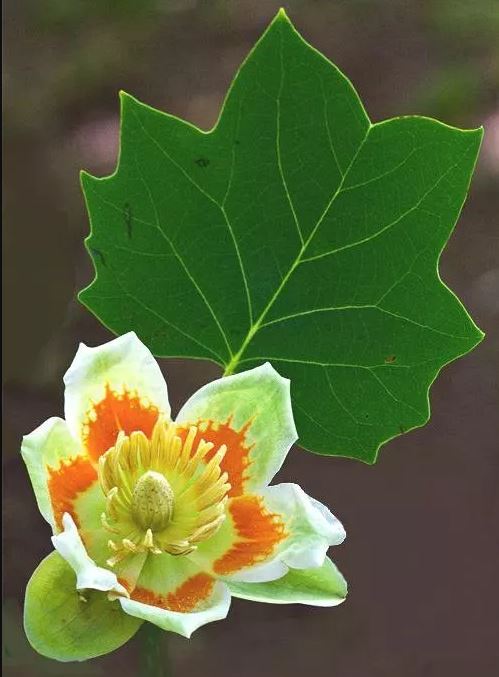
Photo: Wiki Commons
The bark on younger trunks and branches is quite smooth, light ashy-gray with very shallow, vertical, whitish furrows. With age the bark becomes very thick, having deep interlacing furrows and rather narrow rounded ridges.
The bark on younger trunks and branches is quite smooth, light ashy-gray with very shallow, vertical, whitish furrows. With age the bark becomes very thick, having deep interlacing furrows and rather narrow rounded ridges.
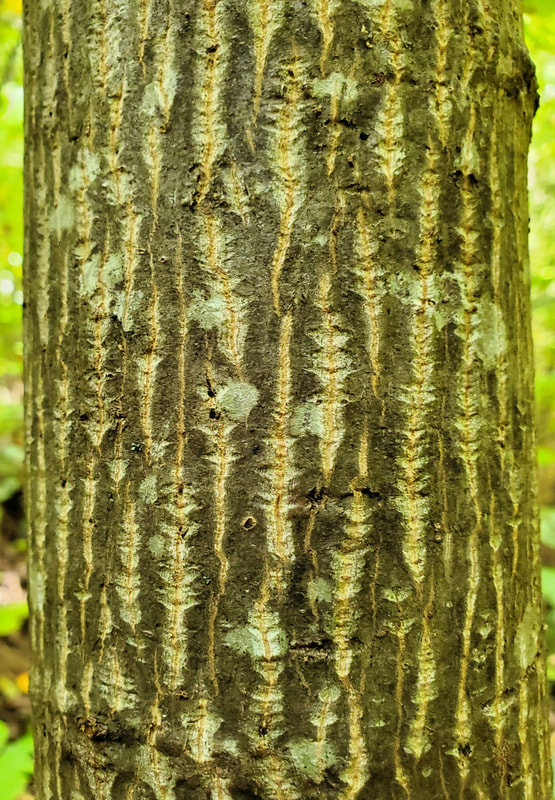
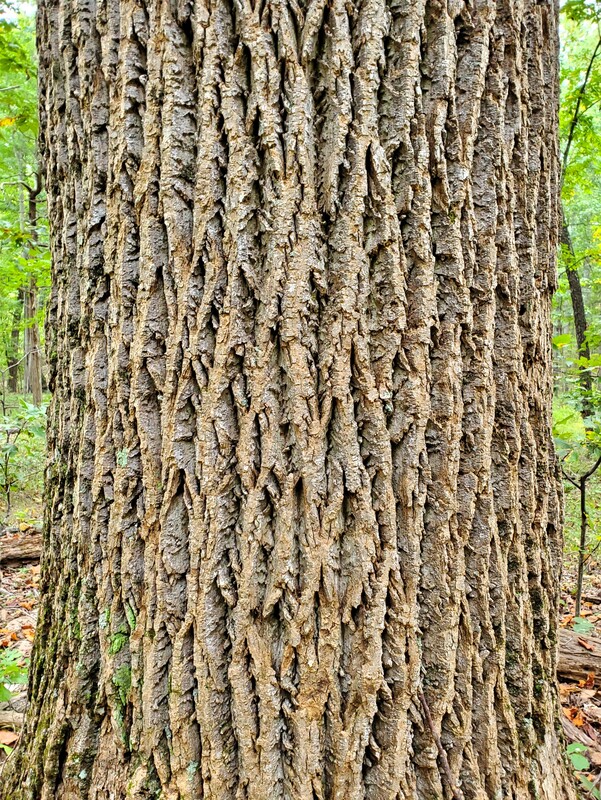
Bark & fruit photos by David Rosher
This tree is rapid-growing, attaining heights of 80 to 120 feet and a trunk diameter of 2 to 5 feet. Its crown has a pyramidal form.
More photos and info: Virginia Tech Dendrology sheet
Tulip Tree is found on a wide range of sites. It grows best on deep, moist, well-drained, loose-textured soils rich in organic matter, but also grows in silty soils and can tolerate clay soil if well-drained. Tulip Tree establishes primarily as a pioneer species, but persists in later successional stages due to its tall maximum height, which enables it to keep reaching the high-light conditions it needs. Tulip Trees are found throughout the Preserve.
Interesting Facts:
This tree is rapid-growing, attaining heights of 80 to 120 feet and a trunk diameter of 2 to 5 feet. Its crown has a pyramidal form.
More photos and info: Virginia Tech Dendrology sheet
Tulip Tree is found on a wide range of sites. It grows best on deep, moist, well-drained, loose-textured soils rich in organic matter, but also grows in silty soils and can tolerate clay soil if well-drained. Tulip Tree establishes primarily as a pioneer species, but persists in later successional stages due to its tall maximum height, which enables it to keep reaching the high-light conditions it needs. Tulip Trees are found throughout the Preserve.
Interesting Facts:
- Tulip Tree fruits provide food for squirrels in the late fall and winter months, and white-tailed deer often browse on the twigs.
- Tulip Tree is the tallest native hardwood in North America. The record holder, at 187.5ft, lives in the Great Smoky Mountains.
- The genus Liriodendron has only 2 species, our Tulip Tree and Chinese Tulip Tree, Liriodendron chinense. The two are very similar in appearance.